Aplicación
La Calorimetría Diferencial de Barrido (DSC) es una técnica de análisis térmico ampliamente reconocida, especialmente diseñada para la caracterización térmica de polímeros y mezclas de polímeros, incluyendo:
- Termoplásticos (polímeros, compuestos de moldeo y otros materiales de moldeo, con o sin cargas, fibras o refuerzos)
- Termoestables (materiales sin curar o curados, con o sin cargas, fibras o refuerzos)
- Elastómeros (con o sin cargas, fibras o refuerzos)
La DSC está diseñada para la observación y medición cuantitativa de diversas propiedades intrínsecas y fenómenos térmicos asociados de los materiales mencionados, tales como:
- Transiciones físicas (por ejemplo, transición vítrea; transiciones de fase incluyendo fusión, cristalización y transiciones polimórficas)
- Reacciones químicas (por ejemplo, polimerización, reticulación y curado de elastómeros y termoestables)
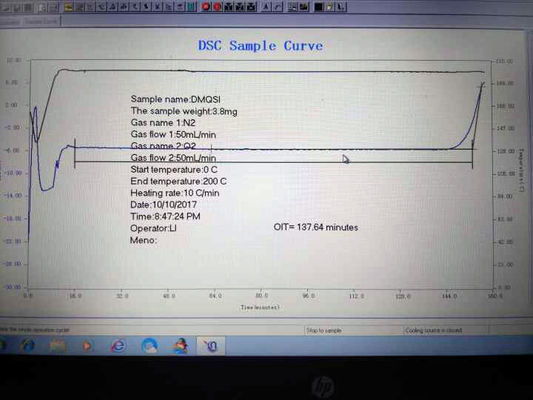
- Estabilidad oxidativa
- Capacidad calorífica
Características del Instrumento
1. Sistema de Visualización
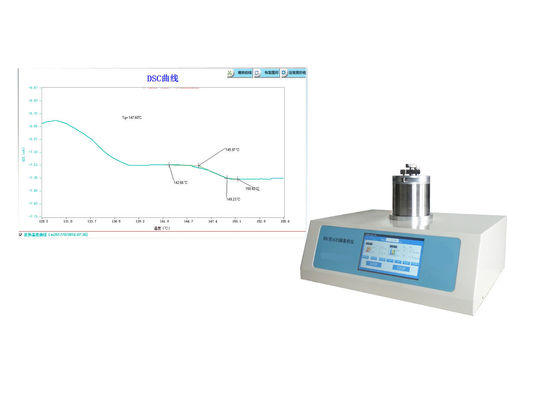
Equipado con una pantalla de cristal líquido LCD con retroiluminación azul, presenta abundante información en tiempo real, incluyendo la temperatura establecida, la temperatura de la muestra, el caudal de oxígeno, el caudal de nitrógeno, la señal térmica diferencial y el estado de varios interruptores, lo que permite un monitoreo integral de los parámetros de prueba.
2. Interfaz de Comunicación
La interfaz de comunicación USB ofrece una gran universalidad, transmisión de datos estable e ininterrumpida, y admite una función de reconexión automática, lo que garantiza una conectividad fiable durante los procesos de prueba de larga duración.
3. Estructura del Horno y Rendimiento de Calentamiento
- El cuerpo del horno presenta un diseño compacto con una velocidad de calentamiento ajustable de forma continua, adaptándose de manera flexible a diversos requisitos de aumento de temperatura para diferentes escenarios de prueba.
- El proceso de instalación está optimizado con un método de fijación mecánica completa, que elimina por completo el riesgo de contaminación de la señal térmica diferencial por coloides dentro del horno, salvaguardando eficazmente la precisión de los datos de prueba.
4. Diseño de Sonda de Doble Temperatura
Este diseño garantiza una alta repetibilidad en la medición de la temperatura de la muestra, abordando las limitaciones de los sistemas de sonda única:
- Una sonda de temperatura montada en la pared del horno implementa el control PID de la temperatura general del horno. Sin embargo, la inercia térmica provoca una cierta desviación entre la temperatura de la pared del horno y la temperatura real de la muestra, y esta desviación varía con las estaciones.
- Para resolver este problema, se instala una sonda de temperatura adicional en la parte inferior de la muestra para medir su temperatura real en tiempo real. Combinado con nuestra tecnología patentada de control de temperatura, la temperatura de la pared del horno se regula con precisión para que la temperatura de la muestra alcance el valor establecido, lo que reduce significativamente los errores tanto en las señales térmicas diferenciales como en los datos de temperatura.
5. Control de Atmósfera de Gas
Un medidor de flujo másico de gas digital permite el cambio automático entre dos flujos de atmósfera de gas. Presenta una velocidad de conmutación rápida y un tiempo de estabilización corto, manteniendo condiciones de atmósfera consistentes y fiables durante todo el ciclo de prueba.
6. Funciones de Calibración y Enfriamiento
- Se proporcionan muestras estándar para facilitar la calibración de los coeficientes de temperatura por parte de los clientes, simplificando las operaciones de verificación rutinarias.
- Se integra una interfaz dedicada de enfriamiento del horno para soportar el enfriamiento rápido del horno, acortando el intervalo entre pruebas consecutivas y mejorando la eficiencia del trabajo.
7. Capacidades del Software
El software se adapta a pantallas de ordenador de diversas resoluciones, ajustando automáticamente el modo de visualización de curvas según el tamaño de la pantalla. Es compatible tanto con ordenadores portátiles como de escritorio, y admite sistemas operativos como Win2000, XP, VISTA y WIN7.
Admite protocolos de prueba programables por el usuario para realizar flujos de trabajo de prueba automatizados. El software ofrece docenas de instrucciones integradas, lo que permite a los usuarios combinar y guardar instrucciones de forma flexible según sus procedimientos de prueba específicos, simplificando operaciones complejas en una ejecución con una sola tecla.
Preguntas Frecuentes
P1: ¿Qué es un Calorímetro Diferencial de Barrido (DSC)?
R1: Un Calorímetro Diferencial de Barrido (DSC) es un instrumento de análisis térmico de alta precisión que mide la diferencia de flujo de calor entre una muestra y un material de referencia bajo condiciones de temperatura programables. Se utiliza ampliamente para caracterizar las propiedades térmicas y los fenómenos térmicos asociados de diversos materiales.
P2: ¿Cuál es el propósito principal de una máquina DSC?
R2: Su objetivo principal es el análisis cuantitativo del comportamiento térmico de los materiales, incluyendo transiciones físicas (transición vítrea, fusión, cristalización, transiciones polimórficas), reacciones químicas (polimerización, reticulación, curado), estabilidad oxidativa y capacidad calorífica. Proporciona datos procesables para respaldar los procesos de I+D de materiales, control de calidad y verificación de cumplimiento.
P3: ¿Qué materiales puede probar una máquina DSC?
R3: Es aplicable a un amplio espectro de materiales, incluyendo, entre otros, polímeros (termoplásticos, termoestables, elastómeros) con o sin cargas, fibras o refuerzos, productos alimenticios, cosméticos, materiales inorgánicos, metales y materiales compuestos.
P4: ¿Cuáles son los parámetros técnicos clave de una máquina DSC?
R4: Los parámetros técnicos clave típicos incluyen:
- Rango de temperatura: Ambiente a 500 °C (hasta 1000 °C para modelos de alta temperatura)
- Precisión del control de temperatura: ±0.1 °C a ±0.5 °C
- Velocidades de calentamiento/enfriamiento: 0.1-100 °C/min (ajustable de forma continua)
- Control de atmósfera: Admite gases inertes (N₂, Ar) o gas oxidativo (O₂), equipado con medidores de flujo másico de gas digital para una regulación precisa del flujo
P5: ¿Con qué normas cumple una máquina DSC?
R5: Cumple estrictamente con las normas internacionales, regionales y nacionales, como ISO 11357 (Análisis térmico de polímeros), ASTM E967 (Método de prueba estándar para DSC) y GB/T 19466 (Plástico - Ensayo de calorimetría diferencial de barrido (DSC)), lo que garantiza la trazabilidad y el cumplimiento de los resultados de las pruebas.


 ¡Su mensaje debe tener entre 20 y 3.000 caracteres!